Tuesday, March 16, 2021

Not All Good Press Is Good Press

Today’s Master of Brands Award goes to Burger King UK, who chose to start a thread on International Women’s Day with the statement “women belong in the kitchen,” a bizarre lead-in to how they’re creating a scholarship program for their female employees to pursue “their culinary dreams,” a statement almost totally bereft of substance that was hooked onto an extremely old and sexist phrase.
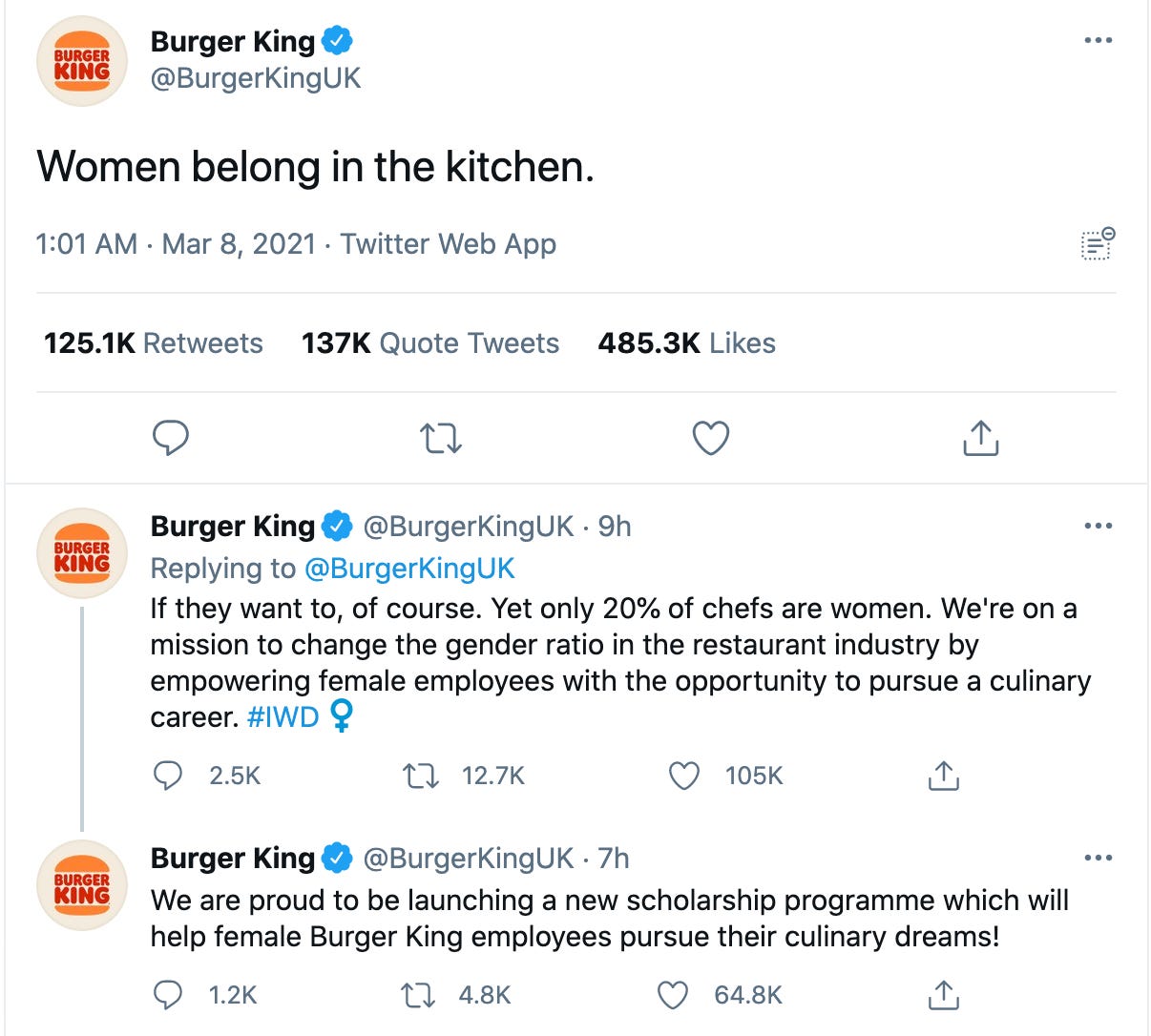
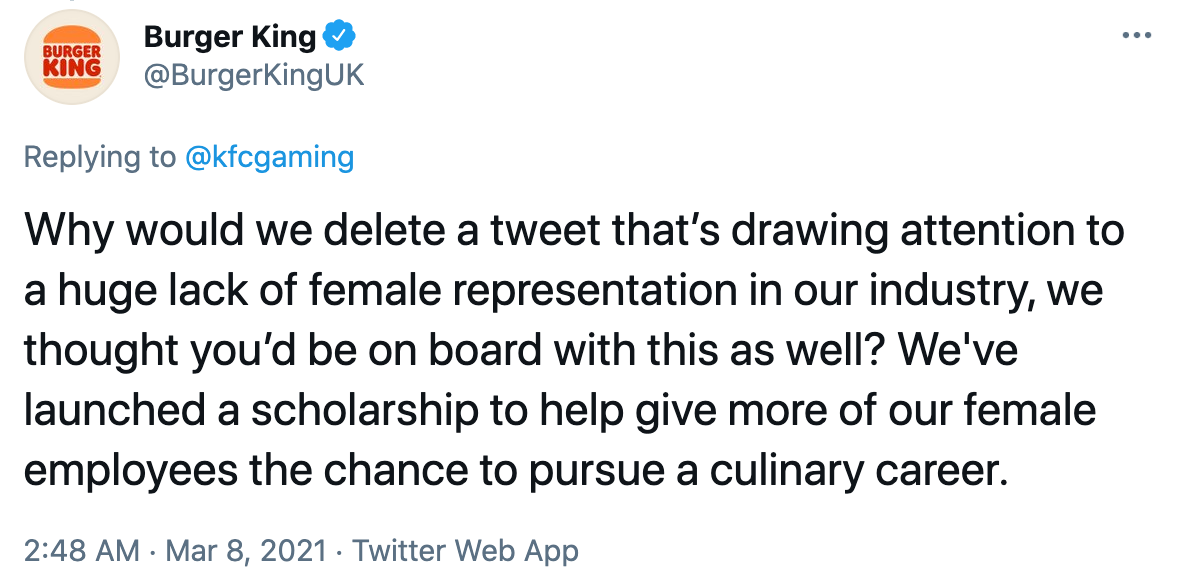
Naturally, when told to “delete this” by another brand account (KFC gaming), Burger King UK decided to double down – which is a KFC dish! Ha! – by suggesting that they should not delete a tweet that brought attention to a lack of female representation in cooking.
According to my good buddy Caylen, Burger King’s agency is BBH (which stands for Bartle, Bogle and Hegarty, possibly the oldest and whitest series of names I’ve ever heard), who you may remember for turning homeless people into hotspots at SXSW about 9 years ago (though that was their “labs” division). Their whole thing is being “controversial” and it works, in the sense that everybody gets pissed off and talks about how much the brand sucks for an entire day.

However, PR loves to conflate lots of impressions about something bad and/or in poor taste as being “successful.” Everybody talking about something is not good, and does not mean that people now remember your brand fondly.

If you go into town wearing a clown outfit and yell “I’m The Big Pee Pee Man” and ram your Dodge Charger into the front of a Piggly Wiggly store blasting Taproot’s Poem, but your car also says “WOMEN’S RIGHTS”, it may indeed be on the news multiple times, but that doesn’t mean that you’ve helped promote Women’s Rights. The news is going to remember you as the clown guy, and at best the clown guy who yelled he was the big pee pee man. People remember shocking and bad things, and tend to not remember context of any kind.

Being Shocking Is Not The Same As Being Daring

I like to draw the line between being shocking and being daring is when you’re attacking a norm versus challenging a bias. The line can be thin as norms are in the process of adjusting, but basically, if you go out and say something that is sexist or racist, that is attacking a norm – it is saying something specifically built to offend or hurt with the intention of eliciting a reaction. This isn’t the same as challenging people’s assumptions about something – calling out biases, problems in society, and so on – it’s the line between making people uncomfortable because they have to question themselves and uncomfortable because you said something shitty to get them to look at you.

That crucial difference is what people tend to miss – they see the increase in attention as a way to reach new people without remembering how first impressions only happen once. Even if the person likes you before, saying something dumb and offensive, even if you end up apologizing for it, proves that you care less about the customer and/or whatever thing you’ve chosen to be nasty about and more about the fact that people are mad. Rob over at BoingBoing mentioned a wonderful term – Schrodinger’s Asshole – which refers to specifically says something rude and then gauges whether or not they were bad for saying it based on how upset everyone gets, which applies perfectly here.

The problem with doing this kind of shock jock form of PR/marketing is its hubris. It acts as if it’s a deft use of the media – controversy building impressions – by harnessing how the media (both social and otherwise) loves negative stories, without realizing that the major story about you is how bad you are.

A new challenger in this space are the people taking advantage of the right wing victimhood narrative. The Goya Beans boycott came from their CEO’s endorsement of President Trump, a guy who had literally called hispanics murderers and rapists, and seeing the freaks rush to say “SIR! I LOVE GOYA BEANS SIR! THANK YOU PRESIDENT TRUMP!” has convinced certain brands (and people) that there is a movement “against” white people and conservative values, which they actually mean is a movement against people being bigots and marginalizing other people.

The temptation here by brands is that there is a “wokeness” that is policing people’s ability to live, and thus it’s good to challenge these things because people are “being too sensitive.” It’s the age old idea that you can sell things by making them good, or sell things by making people think other things are bad, basically fueling their like of something based on their own hatred and anger versus their actual values.

This works sometimes in politics because politicians are good at coming up with shit to make people mad about, but in the case of a brand selling something, hate burns out quickly. People who will buy something entirely out of spite for something else don’t really care about you or the actual quality of the thing you’re selling, and as a result your value proposition is as flimsy as the reasoning behind a person’s purchase.

Sure, you get people who buy and use things to appear a certain way and put out a certain image, but for the most part that only works when something is positive. And that rarely comes from a place of controversy – when someone wears or uses something to say that they support a cause, that’s one thing, but when someone says they’re boldly being rebellious and standing up to a vicious oppressive force by giving someone money the image of sacrifice and struggle is crushed.

While there is an audience of people who are super into people who are assholes (see Trevor Bauer), building a brand entirely based off of outrage and victimhood isn’t a longterm proposition. The size of the audience that is going to be allying with you based on the fact that everyone is mad at you is a lot smaller than you think, and their attraction to you is based on their own subset of directionless misery, and comes with a heaping helping of capriciousness. They will leave you at any time.

They aren’t really your ally – they’re aligned with a vague idea that someone is keeping them from beating the drum of their own biases.

Ultimately there’s no reason to be controversial in this way. Being controversial by saying something to stand out in your industry is fine – my own example being the numerous times I’ve said how bad PR people are, which I did specifically because I want to make it better – but being controversial only to get attention and upset people is bad. It’s useless to you. You don’t need to do it.

This post originally appeared on the “Where’s Your Ed At” newsletter. Read more here.

The post Not All Good Press Is Good Press appeared first on The Future Buzz.

Original source: http://feedproxy.google.com/~r/TheFutureBuzz/~3/RUNMp-ExFgA/

The post Not All Good Press Is Good Press appeared first on connect social networks.


from Connect Social Networks http://connectsocialnetworks.com/not-all-good-press-is-good-press/

Monday, March 15, 2021

How To Write An Email (or Message) People Will Read And Respond To

I have written a lot of stuff recently that’s more on the instructional side, and I promise you that this isn’t going to become a Substack that’s entirely how-to guides. I also realize that the content has begun to oscillate rapidly between cultural analysis and How To Do Stuff, but hey, it’s free, right? If I charged money I’d feel worse about it.

Anyway, I was thinking recently about how my job works, and how much of it really comes down to writing an email that makes someone do something. It’s definitely reductive to say that’s the only thing, but it is also remarkable how often the process comes down to whether I can get someone to do something based on an email or a DM.

Which is why I’m writing a newsletter that’s basically all about how that works, and what it means. Some of this may seem obvious, but based on 99% of PR pitches I see, it isn’t well-known.

Why Am I Sending This Email? And Why Am I Sending It To This Person?

You Suck Come On GIF by The Lonely Island - Find & Share on GIPHY

Oftentimes emails are sent with little regard for their purpose or existence. Sometimes it may seem like they have a point – a PR person sending a “story idea” that’s barely if at all related to you, for example – but doesn’t seem to have that logic flowing through it. The very soul of what you write should be dedicated to actually doing something, and everything in it should be part of that purpose.

Furthermore, the email needs to actually apply to the person it’s going to. This means you should research them and understand not only who they are and what they do, but how you can make the email you’re sending applicable to them.

For example, a bad PR pitch is usually bad because its purpose – “getting a story” – is fairly vague, and doesn’t actually connect to the content of the email itself. A good PR pitch is written and delivered to someone that it’s applicable to, and actually does stuff to get that thing to happen. In essence, you’re not “getting a story,” you’re trying to get the person in question to talk to the client, click a link, read a thing and take action upon it – basically making it easy to do the thing you want so that the other thing you want will happen.

If I’m pitching a reporter with the intention of getting them to cover something, I’ll send them a short email saying what it’s about, and end it with a clear call to action – either here’re the assets for the story (assuming they’re a reporter that would write a story based off of an email, some quotes and images, which does happen in specific industry press), or the same thing but it ends with the assets (because they will need them) and a question of when they’re free to talk to the client in question.

You want to make it clear what you want and give them – the person reading it specifically – everything they need to ideally make the decision you want.

This applies to basically any situation you find yourself in where you need something. You want to be writing something for the person reading it that’s applicable to them with clear intentions.

What Do I Want? And What Do They Need To Know?

Say you’re complaining to a hotel manager that you had a bad stay. The temptation that a lot of people have is to go nuts with threats and nasty words to scare them. That doesn’t motivate anyone! What you want to do is lay out exactly what happened, the consequences of what happened, and what you would like in return. You can even layer on that you’re unhappy, and that you won’t be staying there again unless there’s compensation. The important thing is that the email isn’t simply a screed of anger and poison – even if you feel that way, the person in question likely didn’t personally do the bad thing, and even if they weren’t helpful at the time, being persuasive and illustrative is a hundred times more effective (and moral) than hurting someone.

In the realm of PR, writing an email to someone about something should generally come down to some basic things:

  1. What’s the thing?
  2. What’s new about it?
  3. Why is it relevant to me?
  4. What do I need to do to either learn more or potentially take action on this?

Say I’m pitching Gumbus.AI raised $40 million in a Series B. They’re a company that uses AI to tell you the best vendor for enterprise clients. Most likely a reporter wants to know, on receiving this email, who funded them, when the news is going out, what the company does (in short, but also not so short that it makes no sense) and why it matters to them. The latter part can come simply from good targeting – reading their stuff and understanding what they cover – so you can simply write an email that endearingly tells them there is news, it’s happening here, the news is this, and this is the person to talk to.

It may be a little simpler – say, a reporter you read a lot of that you want to grab coffee with, or learn exactly what they want to hear about. Make the email short and sweet – hey, I read a bunch of your stuff, I know you write about XYZ, but would you wanna grab coffee and chat about what you care about in detail? Or perhaps it’s a simple “are you interested in this kinda thing, I read your stuff and it’s on the edge I think?”

In many cases with reporters it’s not exactly the thing to say “I want you to write about this story,” mostly because their evaluation of whether something is a story doesn’t really come from just an email. What you’re doing is giving them the tools to make that evaluation themselves, and usually them taking a call is a sign that yes, there is potentially a story that they need to investigate themselves.

If you’re trying to talk to an investor about investing, most likely your short email should include the metrics that would matter to an investor – total addressable market, revenue (unless you don’t want to share it in a quick email), growth % over X amount of time, unique things about you and, crucially, a very clear ask at the end – hey, can we grab 30 minutes with you? Can I send you my deck?

You don’t need to include everything, you need to include what’s necessary.

Be Useful (And Easy)

Whatever it is you’re asking, make it the easiest thing in the world to actually deal with. Want them to talk to you for 30 minutes? Give them your calendar availability, or a Calendly link so they can pick one themselves. Need them to speak to a client? Be ready to respond and loop in said client, and please god, respond quickly. Want them to write a story about something based off of your email? Include everything they’d need – pricing, screenshots or images, facts and figures – and make it super easy to read, like in a Google Doc.

Pitching a story that you want to write for an outlet? Make it a tight 4 or 5 bullet point thing that clearly illustrates a narrative, how you’d get the story done, and how much time it’d take, and make it clear you’re available.

Sending a proposal? Lay out exactly what you’d do, who you’ve done it for, how much it’d cost and when you can start.

People who are very good at getting people to do stuff do not do so using black magic. They do so by offering people as quick and easy a decision as possible, directly aligning it with their interests and making the process of saying “yes” as easy to say as “no” as possible. And they accept a “no” gracefully – any response is usually a “thanks for reading anyway” or, if it remotely challenges it, is similarly quick and easy to read and address or dismiss.

A lot of people treat the very basics of communication as a monolith. They want to cram every slice of information into it as possible, and write what they believe is a “compelling email,” when most compelling things aren’t based on the linguistics involved but on the actual content of the words the person is reading.

Obfuscating fact with fanciful language is a great way to get ignored. Writing a huge amount of text is a great way to get ignored. Anything you do that will make the person say “nah, I’m not reading that” is useless to you.

Pragmatism is always your goal. Always. And even if it’s a no, you always want to get your emails or messages read and responded to. If that’s not the goal, what the hell is?

This post originally appeared on the “Where’s Your Ed At” newsletter. Read more here.

The post How To Write An Email (or Message) People Will Read And Respond To appeared first on The Future Buzz.

Original source: http://feedproxy.google.com/~r/TheFutureBuzz/~3/oVBE6FTB828/

The post How To Write An Email (or Message) People Will Read And Respond To appeared first on connect social networks.


from Connect Social Networks http://connectsocialnetworks.com/how-to-write-an-email-or-message-people-will-read-and-respond-to/

Sunday, March 14, 2021

Reshaping The Online Experience For Virtual Events

Reshaping The Online Experience For Virtual Events written by John Jantsch read more at Duct Tape Marketing

Marketing Podcast with Andrew Davis

Andrew Davis - a guest on the Duct Tape Marketing PodcastIn this episode of the Duct Tape Marketing Podcast, I interview Andrew Davis. Andrew is a bestselling author & keynote speaker. He’s built and sold a digital marketing agency, produced for NBC, and worked for The Muppets.

Questions I Ask Andrew Davis:

  • Who is your favorite muppet?
  • You’ve been producing a video show called Loyalty Loop – how many shows do you think you’ve done?
  • As a professional speaker, what are some things you’ve learned about virtual events that you’ve come away with?
  • Adoption of new technologies is on the rise especially in the last few months, and one of those new technologies is virtual reality. Is virtual reality still in the state where only a few people have truly adopted it?
  • Have you studied virtual reality enough to be able to recommend the right headset or what device you should get?
  • How do we get more engagement on Zoom?
  • How have you altered your presentations for a virtual audience?
  • Are you producing any events?

More About Andrew Davis

  • Andrew’s show: Loyalty Loop
  • LinkedIn: Andrew Davis
  • Instagram: @andrewdavishere

More About The Duct Tape Marketing Consultant Network:

  • Check it out at https://ducttapemarketing.com/marketing-consultants/

Like this show? Click on over and give us a review on iTunes, please!

Layr is redefining the way businesses purchase and manage their commercial liability insurance by giving control of the process back to the business owner.

We are a modern tech-enabled insurance agency that has created an entirely new commercial insurance distribution model which allows businesses to quickly get the insurance they need, completely online, from trusted insurance carriers, all while paying for it monthly on a credit card. Learn more about Layr here.


Original source: https://ducttapemarketing.com/reshaping-online-experience-for-virtual-events/

The post Reshaping The Online Experience For Virtual Events appeared first on connect social networks.


from Connect Social Networks http://connectsocialnetworks.com/reshaping-the-online-experience-for-virtual-events/

Saturday, March 13, 2021

Trusy Social Discusses Marketing Through Instagram

Marketing a business through social media is essential for
the modern-day market. Social media can help people feel connected to each
other, institutions, companies, and small businesses. By creating a social
platform for business, brand awareness can spread by using an organic method.

Best Social Platforms

There are a variety of social media platforms to choose from
when it comes to marketing. While they may look similar at first, each site can
have slightly different benefits depending on a user’s needs.

Benefits

Social platforms have several key components that are ideal
for any business.

  • space to write
  • opportunity for visual branding
  • current updating
  • communication options

These four benefits allow potential clients or customers to
interact with a business on various levels. By providing the space to write,
the personality of the brand or business can shine. Writing blogs or updates or
captions can remind users that the business is alive and fully integrated into
the social community.

Visual Branding

Visual branding is another crucial aspect of any brand.
Visual branding does not just mean a logo or featured image. By adding visual
components to a social media site, a business can make a quick impression that
can last even if a user does not click on it. Since repetition is one of the
most effective ways to market, this can be especially helpful for scrolling
sites.

Regular Updates

Updating regularly allows potential clients and customers
multiple opportunities to engage with content. Updating can mean a variety of
options depending on the platform. Some of these options can include a sentence
or two, a blog post, a picture, or a contest.

Encourage Communication

Social media sites are an easy way for businesses to
encourage communication. Typically done by various messaging options and
buttons helps engage users to follow. Companies can answer any potential
questions, encourage clients or customers to get to know them and demonstrate
their brand’s personality.

Why Instagram?

Instagram is one of the most famous platforms for visual
content. By relying heavily on images, this site is ideal for businesses that
may only have a short period of time to grab someone’s attention.

Engaging Content

Photographs typically have more site-engagement than other
forms of posting. Since Instagram is a social network with over 1 billion
people, it has enormous potential to help businesses grow. Many Instagram users
follow at least one company.

Community Growth

As the company Trusy Social knows, every business with a
social media presence wants followers. Instagram followers create a potential
business as well as opportunities for further marketing ability across the web.
By conveying emotion, showcasing offers, and highlighting relevant data,
businesses can increase traffic to their site.

Instant Content

Visual content is instant. Unlike social platforms that rely
more on text-based communication, Instagram bases their platform on pictures.
Visual content can be seen and understood regardless of language barriers. This
is an essential factor when it comes to increasing brand awareness. These
photos are processed several times faster than text, but their reach is
ostensibly far wider.

What Are the Methods?

Content Curation

When marketing a business on Instagram, content must be
updated regularly. Content should be fresh, clever, and engaging to a core and
wide audience. Content and social marketing companies like Trusy Social can
drive traffic and increase impressions and followers by rapid content
production. This can be done by scheduling posts and analyzing the business’s
market.

Focus on A Story

Each business has a story they can expand upon to build their
brand successfully. Whatever that story may be, whether it’s inspirational or
quirky, the images posted can help. Site users who are captivated by the “why”
of a business can feel engaged from the start. This is more likely to lead to a
genuine connection than a photograph that simply does the trick.

Tagging

Tagging is an effective trick to marketing a business on
social media. By tagging pictures with people or locations, the photo is more
likely to be seen by additional users. Tagging to specific people may also
provide an additional audience that could be more interested in a local
business. When first marketing a brand, a wide reach is ideal.

Staying Attentive and Active

Staying active and paying attention are critical to any
marketing plan. Scheduling which posts are posted when can allow a business to
monitor its progress and triumphs. Taking note of which photos have engaged the
most users can point to a successful user engagement pattern. Instagram
reporting tools can show which hashtags have performed the best as well as
other media metrics.

Celebrity Partnerships

Professional influencers can have a major impact on
potential clients or customers. Trusy Social has a partnership plan that
includes top influencers to help businesses grow. Using celebrities to
encourage local and global followers, businesses can benefit from an organic
growth strategy.

Wrap Up

As of 2019, 7 out of 10 Americans used social media. Since
then, the number is only rising. Marketing a business through social platforms
such as Instagram can be highly beneficial for brand awareness. By showing a
company’s personality, clients and customers can relate in a new and personal
way. Although social media may seem like a personal space for hanging out, a
marketing strategy is hard work when used to build a business platform.
Consistency, tailored content creation, and communication are the keys to a
successful marketing campaign.  

The post Trusy Social Discusses Marketing Through Instagram appeared first on Social Media Explorer.

Original source: https://socialmediaexplorer.com/digital-marketing/trusy-social-discusses-marketing-through-instagram/

The post Trusy Social Discusses Marketing Through Instagram appeared first on connect social networks.


from Connect Social Networks http://connectsocialnetworks.com/trusy-social-discusses-marketing-through-instagram/

Friday, March 12, 2021

Finding Joy In Your Business

Finding Joy In Your Business written by John Jantsch read more at Duct Tape Marketing

Marketing Podcast with Shani Godwin

Headshot of Shani Godwin - a guest on the Duct Tape Marketing PodcastIn this episode of the Duct Tape Marketing Podcast, I interview Shani Godwin. Shani is the founder of Communique USA. She has created a new program called JOY Economics which is a coaching program that teaches entrepreneurs how to turn their personal stories into powerful brand content.

Questions I Ask Shani Godwin:

  • Tell me about how you started Communique USA nearly two decades ago.
  • Can you tell me more about your coaching program, JOY Economics?
  • Was creating this program a pivot for you as an agency?
  • What are the basics of JOY Economics?
  • How do you measure joy?
  • How do you help people identify and work on breaking habits that ultimately end up causing stress?
  • Can you share some stories from people that you’ve worked with who have made significant changes?
  • Since the pandemic started, have you witnessed an even greater desire for this idea of bringing joy back into their business, or are we still in panic mode?

More About Shani Godwin:

  • Claim your free JOY Assessment
  • Instagram: @iamshanigodwin
  • Subscribe to Shani’s YouTube Channel

More About The Certified Marketing Manager Program Powered By Duct Tape Marketing:

  • Check it out at Ducttapemarketing.com/certified-marketing-manager 

Like this show? Click on over and give us a review on iTunes, please!


Headshot of Sophia Godkin

This episode of the Duct Tape Marketing Podcast is brought to you by .site.

Have you ever tried looking for a domain name? Chances are that the first few options you tried were not available. You are not alone!

Now you have the power to change this. You can get the exact domain name that you want on new domain extensions such as .site. It is short, it is simple-to-understand and it literally means “website” so it’s perfect for any website that you might be building.

In fact, I got myself www.selfreliance.site where I talk about my book ‘The Self Reliant Entrepreneur’ and share content to help people become self-reliant in their entrepreneurial journey.

You too can get your very own .site domain for as low as $1.99. Visit www.get.site. Search for your unique .site domain and use code ‘selfreliance’ to get 50% off on your domain purchase.

Original source: https://ducttapemarketing.com/finding-joy-in-your-business/

The post Finding Joy In Your Business appeared first on connect social networks.


from Connect Social Networks http://connectsocialnetworks.com/finding-joy-in-your-business/

Thursday, March 11, 2021

What’s Your Signature Response to Problems?

What’s Your Signature Response to Problems? written by John Jantsch read more at Duct Tape Marketing

One of the ways to create goodwill, positive buzz, and happy customers is to exceed expectations. Responding proactively to problems is, in my opinion, one of the easiest ways to exceed the expectations available.

Problems happen, that’s a fact. You can choose to respond to customer challenges, problems, let downs, screw-ups, and mistakes in one of two ways. You can ignore them and create the kind of friction that drags your trust into the ground or you can respond in such an over-the-top, out of control, nobody does that kind of way that can turn problems into gold mines. If you want to exceed expectations, choose the latter!

For the longest time, Nordstrom had a policy that granted refunds with no receipt, no time limit, no questions asked. A variation of that policy still remains today. This policy is often an example given whenever someone talks about customer service. But it’s really a signature response to a customer problem, and it’s become something that creates incredible word of mouth for them.

Creating what I call your signature response to problem-solving takes a little thought, planning, implementation, and even training, but it can become a very valuable tool for your organization. I’ve mapped out four things you can do to quickly, proactively, and creatively address customer problems with a signature response of your own. 

1. Invite and reward customer feedback

The first step to making problem-solving a core marketing system is to encourage your customers to tell you when something’s not right. This may sound like a simple thing, but there is plenty of research that suggests somewhere near 90% of your customers experiencing an issue will simply go away quietly unhappy.

You should clearly state in all your marketing copy that you welcome feedback and won’t rest until your customer is thrilled. Spell out guarantees, return policies, and make it very obvious how to get in touch with you via phone, mail, live chat, web, or email. You should also build satisfaction surveys, results reviews, and even random phone follow-ups into your standard operating procedures.

Of course, it’s not enough to just ask for feedback and then send it down a black hole; you’ve got to respond.

2. Create a response

In order to get the full impact with this idea, you need to design the manner in which you will automatically respond in order to solve a customer problem. Some of this can and should be handled through clearly spelled out, no strings attached, guarantees, and return policies, but you need to add some flair as well. Adding some creativity in this step is how you turn a response into a signature response. For example, does the CEO show-up with a bouquet of flowers, does the customer immediately receive a month of service free and a dedicated service rep to help guide them through the challenge, do you do whatever it takes to make it right?

The key here is to do something that gets the customer the result they are after but also offers a little ‘wow’ that they can’t help but notice because it was unexpected.

Occasionally, we receive notes from customers who have purchased one of our products but feel it isn’t what they thought it would and want to return it. We cheerfully refund their purchase price, but instead of asking them to return it, we ask that they make it a gift to another business owner. It’s a pretty simple thing on our part, but it really creates a warm response each time we offer it.

3. Act quickly

Speed matters in problem-solving – especially in a technology-filled world that caters to and sustains our desires of instant gratification. You need to act quickly. A fast response time makes customers feel that their concerns are important. In a study by CMO Council, the most important attribute of a good customer experience, according to the customers themselves, is a fast response time.

Zappos is well known for its incredible customer support. They have live chat, email, phone, and social support available 24/7. Customers expect their problems to be solved and fast – it’s another prime example of a signature response they designed for themselves.

4. Empower your team to fix the problem

Another really important piece of the problem-solving puzzle is blame. When you make a mistake, admit it, and move to fix it. When your customer makes a mistake, well, move to fix it. There’s no gain in getting the customer to admit they were wrong, even when they are. One of my favorite business expressions said to my staff in my best dad voice is: Fix the problem, not the blame.

The way to make sure that your signature response to problems is actually delivered as designed is to empower your staff to fix the problem, not the blame!

Let them know that while you have a set of policies designed to make their life simple and your business profitable, they can do what it takes to make the customer happy. Now, if that makes you more than a little nervous that you will be taken advantage of then perhaps you need to refine whom you are attracting as customers. There will always be people who try to take advantage of your willingness to please, but the key lies in setting the proper expectations upfront in all of your marketing messages.

Saving a deal gone bad by reacting in a way that is generally unexpected is how you create positive buzz and customers for life.

  • Customer Service Is Defined By Customers (staygolinks.com)
  • Guide: A Brand Strategy Checklist (thecauseisthehabit.com)
  • Seven Steps to Better Customer Referrals (myventurepad.com)
Reblog this post [with Zemanta]

Original source: https://ducttapemarketing.com/whats-your-signature-response-to-problems/

The post What’s Your Signature Response to Problems? appeared first on connect social networks.


from Connect Social Networks http://connectsocialnetworks.com/whats-your-signature-response-to-problems/

Wednesday, March 10, 2021

How to Untangle Messy Workplace Communication

Today’s average office environment does not exactly suffer from a lack of communication channels. A nearly constant drip-drip-drip of emails, Slack exchanges, text messages, video calls, and impromptu hallway conversations can easily overwhelm. Not only is bouncing back and forth between communication channels stressful, it can be incredibly inefficient and time-consuming.

Picking the right channel for workplace communication can help ensure that your team keeps running on all cylinders. Is the message you’re sending best delivered via Slack, email, or — gasp — in person? Use these suggestions to untangle communication lines and keep your team focused on the task at hand rather than attempting to decipher your message.

1. Use the Right Tech Tools

Many workplace communication issues can be addressed through the thoughtful implementation of the right tools. If you want to stop answering the same questions over and over, implement a company wiki. This software solution can contain nearly all the information your team will ever need to access, all in one place. Keep it updated, and it will be an invaluable asset. 

You should also consider implementing project management software. When employees share a single platform, they needn’t waste time spent sifting through lengthy email chains and direct messages. Instead, communication is project-specific and tracked within the software.

Nearly all platforms allow system administrators to assign roles to each user to help avoid confusion and streamline productivity. Managers can map out project details and assign tasks to specific roles, avoiding email entirely. As soon as assignments are made, the team can get straight to work.

2. Improve Meeting Habits

Research suggests that up to 15% of the time spent in an hour-long meeting is wasted just setting up the equipment. In fact, tens of billions of dollars are squandered each year on ineffective meetings. Lack of preparation, drifting from the agenda, and meeting more frequently than necessary are all virtually guaranteed to waste time and confuse teams.

The first step to addressing this waste is to reconsider how many meetings you hold. Some teams thrive with weekly or even daily meetings. More often than not, though, it’s better — and much less complicated — to replace meetings with effective communication throughout the day. (There’s a reason “This meeting could have been an email” is an increasingly popular catchphrase.)

Schedule meetings somewhat begrudgingly. Is there a better way to communicate? Can meetings be reserved for special events, training, or quarterly recaps?

The next step is to create consistent, clear practices around meetings. Provide an agenda that sets time limits on topics to be discussed and stick to it. Check a few hours in advance to make sure all key participants will be able to attend that day. If not, reschedule the meeting or cancel it. 

3. Develop Communication Protocols

In the absence of a plan to direct communication traffic, channels will quickly become cluttered. Anyone who has stopped working to check a message that had absolutely nothing to do with them knows the impact this has on productivity.

Linear communication protocols are common in larger organizations. Employees are instructed to speak to their managers but are not given permission to “jump the line” and speak directly with board members or the CEO. Flat organizations such as startups and family-run businesses can come up with more relaxed, but still straightforward, communication protocols. This will help ensure that an employee question or comment will go — on the first try — to the person who can best address it.

4. Require Your Team to Share a Calendar

Another tech investment to consider is an online calendar for your team. An online calendar helps your employees better manage their own time, but it also improves communication. When you can see a colleague is in a meeting, you won’t call their cell phone. You’ll also know to send an email they can respond to afterward rather than a Slack message that begs an immediate reply.

Look for an online calendar solution that can be easily shared and has scheduling links. Scheduling links allows everyone on your team to share their availability with co-workers and clients. This virtually eliminates those annoying back-and-forth emails as you try to coordinate schedules.

A shared team calendar can also record due dates and submissions, providing information that might otherwise generate an email or phone call. Any asset you use to cut down on short bursts of messaging will do wonders to declutter your communication channels.

5. Break Down Communication Barriers

Identify the communication problems within your organization. Are employees afraid to talk to you? Is a lack of camaraderie on the sales floor leading to miscommunications and frustrations? The first step is to uncover and track these issues without moving too quickly or assigning blame.

Encouraging team bonding outside the workplace tends to break down boundaries and help team members loosen up. Consider sponsoring a team dinner after hours or take the crew out bowling. Talking to each other more naturally outside of the office encourages better communication during the workday. Over time, employees will feel more comfortable addressing their questions and concerns with you as well.

Another way to break down communication barriers is to host a training seminar. The introduction of a new software package, for example, can provide a good opportunity to hold a workshop where communication protocols are reinforced. While being careful not to single anyone out, offer examples of poor communication side by side with an effective counterpart.

6. Promote Transparency

Transparency in the workplace promotes trust, collaboration, and accountability. Each of these attributes provides a boost to overall morale and dramatically improves communication.

The best way to promote transparency in the workplace is to start at the top. Strive to be consistently open with employees regarding policy changes, expectations, and company stability. If applicable, seek out opportunities for one-on-one time with every employee, while being careful to avoid the perception that you are micromanaging.

Transparency promotes a healthier, happier workplace. Your employees will communicate far better in an environment where they feel safe and included.

7. Review Hiring Practices

By assessing communication skills as part of your standard hiring practices, you can frequently nip future communication issues in the bud. 

In addition to assessing verbal communication during an in-person interview, ask all applicants to complete a short, handwritten Q&A on the spot. Depending on the position, you might even require a written exam. Do your best to screen applicants for the right balance of tangible skills and communication prowess.

Don’t wait until you can’t take it anymore to begin untangling workplace communication issues. It might be tempting to sidestep these as “not a priority” when a client project is making its way toward completion. While it’s fine to prioritize, don’t let communication snafus fall off the table, either. Unaddressed, they tend to come back to take a bite out of productivity.

The post How to Untangle Messy Workplace Communication appeared first on Social Media Explorer.

Original source: https://socialmediaexplorer.com/business-innovation-2/how-to-untangle-messy-workplace-communication/

The post How to Untangle Messy Workplace Communication appeared first on connect social networks.


from Connect Social Networks http://connectsocialnetworks.com/how-to-untangle-messy-workplace-communication/